Airports of Thailand has signed two public-private partnership agreements bringing a third ground handling and cargo operator into Suvarnabhumi Airport, a move the operator says will cut delays after a flooding-driven baggage backlog exposed how thin the airport’s handler base had become.
Airports of Thailand (AOT), which runs Bangkok’s main international gateway, signed the agreements on 8 October 2026 with AOT Ground Aviation Services (AOTGA), a subsidiary formed through a joint venture with SAL Group of Thailand. One agreement covers apron services, ground support equipment, passenger handling and related ramp operations; the other is a standalone cargo warehouse development running to a 25-year contract term.
AOTGA becomes Suvarnabhumi’s third ground handling and cargo provider, a structural change rather than a tweak to the existing roster. Ground handling operations are set to start in 2027, giving the new operator roughly a year to recruit staff, procure equipment and clear operational readiness checks. The cargo warehouse project carries its own clock: about 23 months of construction and preparation before it opens.
The timing matters more than the contract term. Severe flooding hit Bangkok in late September 2026, stopping ground handling staff from reaching work and leaving Thai Airways facing baggage backlogs and temporary cargo handling restrictions. AOT frames the new agreements explicitly as business continuity cover, built to stop a single-point weather event from freezing both passenger and freight operations again.
Thailand’s Cabinet approved the move on 8 September 2026, and the contracts signed by AOT President Paweena Jariyathitipong and AOTGA General Manager Siriwat Towachirakul carry key performance indicators on service efficiency, backed by penalties and fines for operators that miss them. That is the commercial lever: airlines now have a written standard to point to if turnaround times slip, and a competitor operator for AOT to shift volume toward if one handler underperforms.
For other hub operators, the read-across is the resilience logic rather than the specific deal size, which AOT has not disclosed. Airports that run on two handlers are effectively betting that neither goes down at once, a bet that failed at Suvarnabhumi when flooding hit staffing rather than the handlers’ systems. It is the same single-provider risk that pushed Kuala Lumpur to add Menzies Aviation as a second passenger handling licence holder, and the same calculation behind Swissport’s entry into Indonesia through a joint venture with UNEX rather than a standalone bid.
The cargo side sits alongside a separate trend: airports building dedicated warehouse capacity ahead of freight growth rather than retrofitting it later, the same logic behind WFS’s new 25,400 square metre cargo hub at Lyon Airport. With global passenger volumes already at record levels, as ACI World’s count of 9.8 billion passengers in 2025 shows, the pressure on handler capacity at major hubs is not going away.
For airlines operating out of Suvarnabhumi, the practical move is to get KPI terms into ground handling contracts with AOTGA now, while the operator is still building its 2027 service model, rather than negotiating after volumes ramp up. For airports elsewhere watching the floods, the lesson is cheaper than a new terminal: a third handler is a continuity policy, and it costs less than the backlog it prevents.
The original announcement was reported by AviationPros. More detail on Airports of Thailand’s operations is available via AOT’s own site.
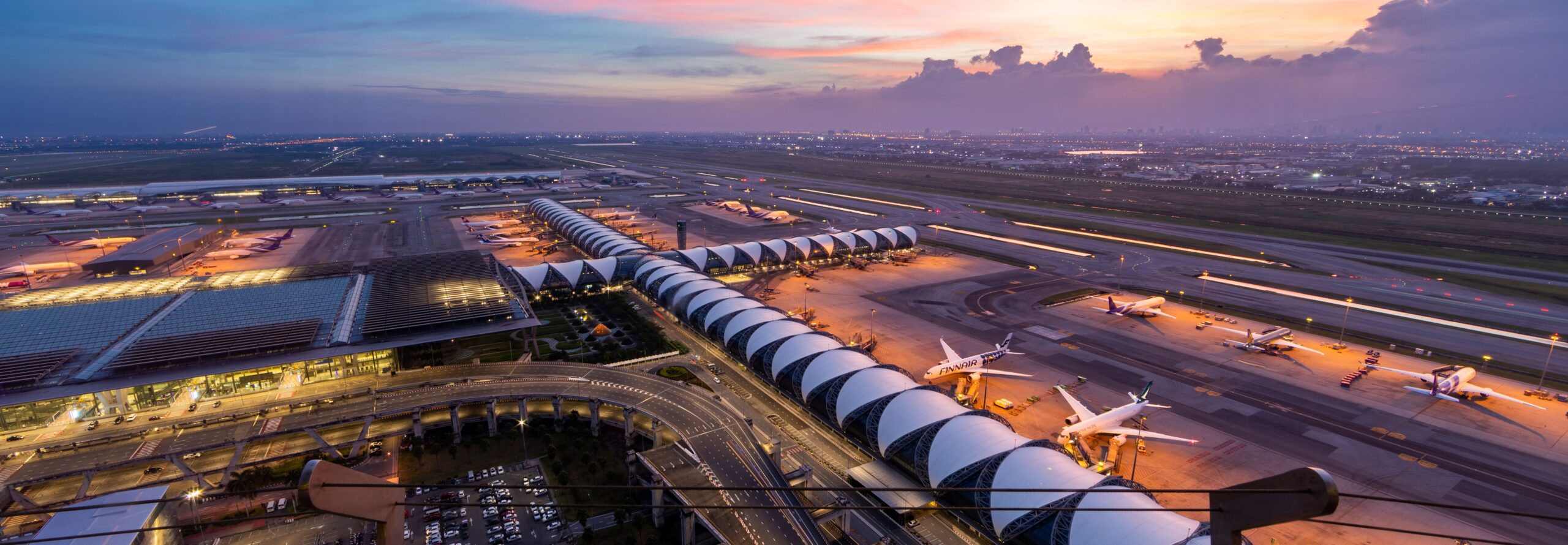
Photo: airportthai.co.th