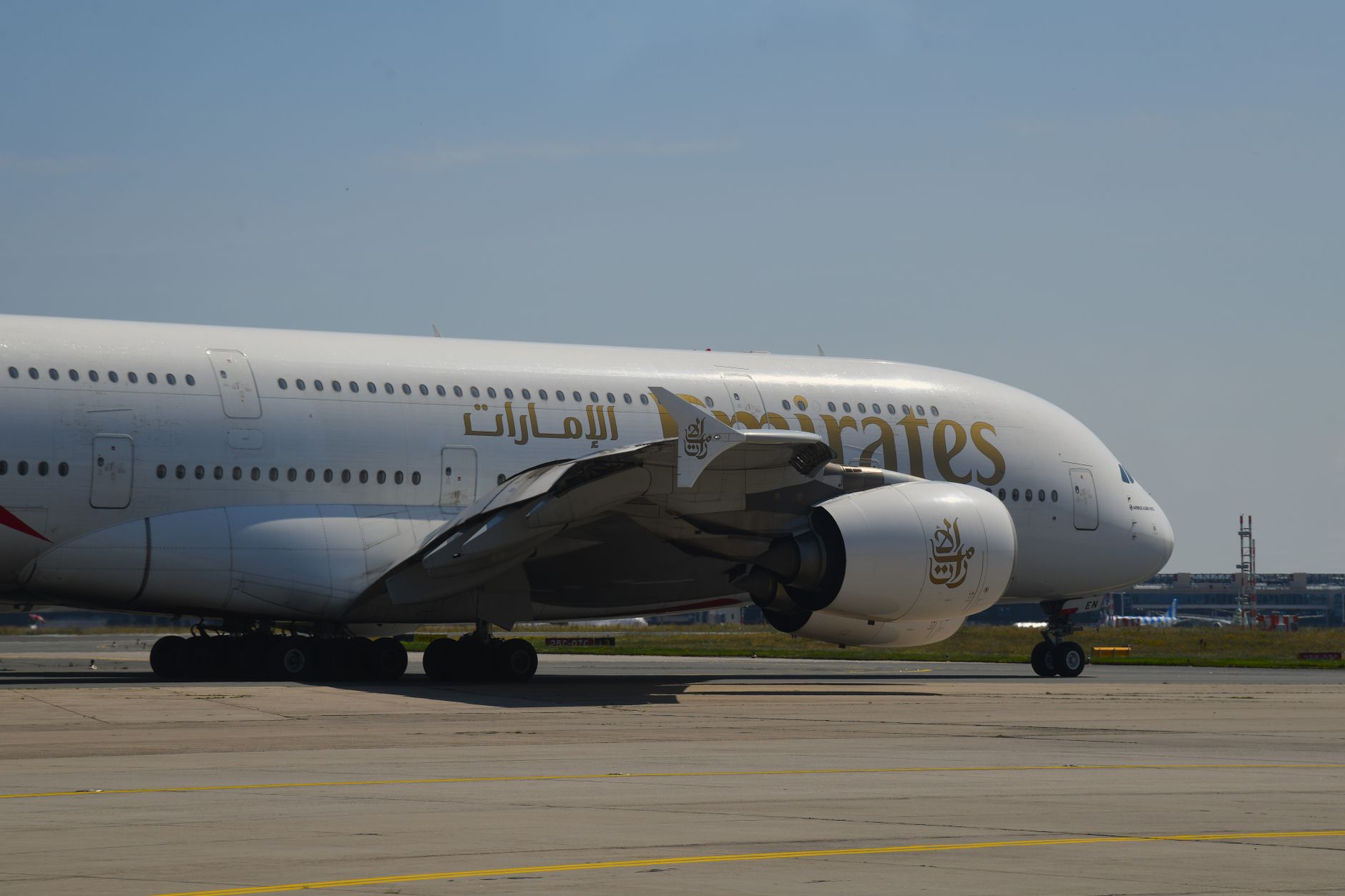
An Emirates A380 operating flight EK31 from Dubai to London Heathrow squawked 7700 and diverted to Frankfurt on 1 October 2026 after a passenger suffered a medical emergency onboard.
The Emirates flight EK31 Frankfurt diversion saw the double-decker aircraft break off its scheduled run to Heathrow, land at Frankfurt Airport, and resume its journey hours later once the passenger had disembarked for treatment.
Flight EK31, registration A6-EDX, departed Dubai International Airport at 07:30 UTC for a scheduled 7 hour 20 minute flight to Heathrow, according to AIRLIVE. Roughly six hours into the flight, while cruising at 40,000 feet over European airspace, the crew transmitted squawk 7700, the international transponder code for a general emergency, and requested a divert vector to Frankfurt. The aircraft landed on runway 25L at 16:09 local time and was parked on a remote stand. AOL reported an Emirates spokesperson confirmed the diversion was “due to a medical emergency involving a passenger onboard,” adding that “our cabin crew provided assistance during the flight, and medical support was arranged on arrival. The aircraft landed safely in Frankfurt, where the passenger disembarked to receive further medical attention.” The aircraft departed Frankfurt again at 18:10 local time, per AIRLIVE, with arrival into Heathrow scheduled for 18:38.
Why it matters to the airport that catches the diversion
Frankfurt did not plan to handle an A380 that day. The aircraft type carries an average of 484 to 615 passengers depending on cabin configuration, per AOL’s reporting, which means a diversion airport has to find apron space, stairs or a jet bridge rated for the aircraft, ground handling capacity, and a medical response team at short notice, all while its own scheduled traffic keeps moving. A squawk 7700 declaration also triggers priority routing and expedited vectors from air traffic control, so the receiving airport typically gets a short warning window rather than none, but that window is measured in minutes, not hours.
For the destination airport, Heathrow in this case, the cost shows up differently: rebooking connecting passengers, re-planning a delayed arrival slot, and absorbing a late inbound aircraft into an already-tight schedule. Emirates said in its statement to AOL that it was managing rebooking for affected connections.
What it means in practice for operations teams
A medical diversion is one of the more routine entries in an airport’s emergency playbook compared with a technical failure, but it still consumes the same resources: a remote stand, ground crew, an ambulance crew airside, and coordination between air traffic control, the airline and ground handling. The governance questions that boards should be asking of their own diversion and emergency response plans are close to the ones ACI World’s runway overrun guidance sets out for other low-notice emergency scenarios: who has authority to allocate a stand immediately, how fast medical services can reach an aircraft on a remote pan, and how the airport communicates with the airline’s operations centre in real time.
That real-time coordination is increasingly software-driven. Operations platforms that link flight data, stand allocation and ground service dispatch, the kind Montréal-Trudeau has deployed from Veovo, or the integration Veovo and Overdrive IoT have built between their two platforms, are built precisely for this kind of unscheduled event: an unplanned widebody arrival that has to be slotted into a live operation without displacing everything else on the board.
What to do now
- Check that your diversion protocol names a single decision-maker for remote stand allocation, rather than routing the call through multiple departments during a live emergency.
- Confirm airside medical response times to your furthest remote stands, not just to the terminal gates.
- Review ground handling contracts for widebody capability on short notice, including stairs or mobile lounges if an A380 or 777 diverts in and no compatible jet bridge is free.
- Test the data link between your operations platform and the diverting airline’s control centre before an incident, not during one.
What caused the Emirates EK31 Frankfurt diversion?
Emirates confirmed to AOL that the diversion was due to a medical emergency involving a passenger onboard, not a technical fault with the aircraft.
Where did Emirates flight EK31 land?
The A380 landed at Frankfurt Airport on runway 25L at 16:09 local time on 1 October 2026, according to AIRLIVE, after being vectored there following the squawk 7700 declaration.
Did the flight continue on to London?
Yes. AIRLIVE reported the aircraft departed Frankfurt at 18:10 local time, with arrival into London Heathrow scheduled for 18:38, after the affected passenger disembarked for medical treatment.
The takeaway: a medical diversion cost Frankfurt an unplanned widebody turnaround and Heathrow a delayed arrival, and the only variable an airport controls in that sequence is how fast its own stand, medical and data systems respond.