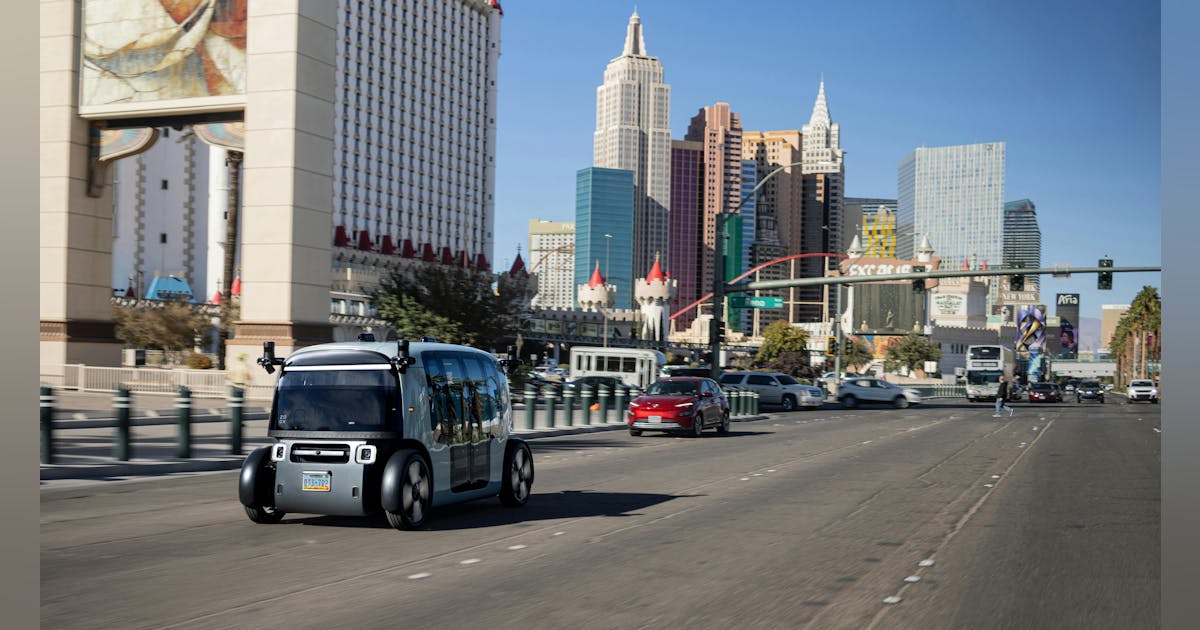
The Zoox robotaxi service has begun fully driverless operations at Harry Reid International Airport, the first airport deployment of the technology anywhere, while three approved rivals, including Waymo and Tesla Robotaxi, wait for their own clearance to follow. The move matters to anyone running landside operations because it puts a driverless fleet directly into the curbside mix, competing for the same pickup lanes, dwell time and, eventually, the same revenue that parking and taxi concessions currently generate.
The service covers both terminals at LAS. At Terminal 1, riders are dropped at the Departures/Ticketing level and picked up on Level 0 below baggage claim; at Terminal 3, both pickups and drop-offs happen on Level 0 outside baggage claim. Passengers book through the Zoox app, which routes them to a designated waiting area, and luggage travels on the floor of the passenger compartment since the purpose-built vehicles have no steering wheel or pedals to work around.
The launch follows several months of testing and mapping around the airport, a technology rollout pace also tracked in FAA’s surface surveillance installation milestone, carried out as Zoox worked with the Clark County Department of Aviation to satisfy the county’s requirements for serving LAS. James C. Chrisley, Clark County director of aviation, called it “a first for this technology in an airport environment” and said the deployment gives the airport “an opportunity to help shape how emerging technologies can be integrated within a complex airport environment,” according to AviationPros. The staged approach, mapping and testing ahead of a public go-live, mirrors the kind of systems rehearsal covered in Jetstar’s trial flight testing Western Sydney Airport’s systems before opening, where operational proving runs ahead of the public launch rather than alongside it.
Zoox is currently the only autonomous vehicle operator authorised at LAS, but it will not be alone for long. The Nevada Transportation Authority has already approved network applications from Waymo, Tesla Robotaxi and Aviari Services to run paid passenger transport across Clark County, though each still needs separate sign-off from the airport before operating on-site. The airport service extends a commercial robotaxi operation Zoox had already begun running in Las Vegas, according to the AviationPros report.
For terminal and landside managers, the immediate question is not whether robotaxis work, Zoox has already proven that on public roads, but what a multi-operator autonomous curb does to a facility built around drivers, dispatchers and metered parking. Ground transportation revenue sits alongside parking as one of the steadier lines in the non-aeronautical mix described in Airport Business Magazine’s benchmarks on what airports earn per passenger, and a shift toward driverless fleets changes who an airport negotiates concession fees with. It also raises the same integration questions airports are already working through with other automated pilots, of the kind detailed in CVG and Munich’s live agentic AI pilots, where the warning was against adopting new technology for its own sake rather than a proven operational gain.
Airports watching this from outside Nevada should treat LAS as the test case rather than the template. The practical task now is mapping curbside capacity, concession contracts and permit conditions against a scenario where three or four autonomous operators, not one, are requesting dedicated pickup zones within the next year, and pricing that shift into parking and ground transport revenue forecasts before a rival airport signs first.
Image: aviationpros.com