By Airport Business Magazine staff
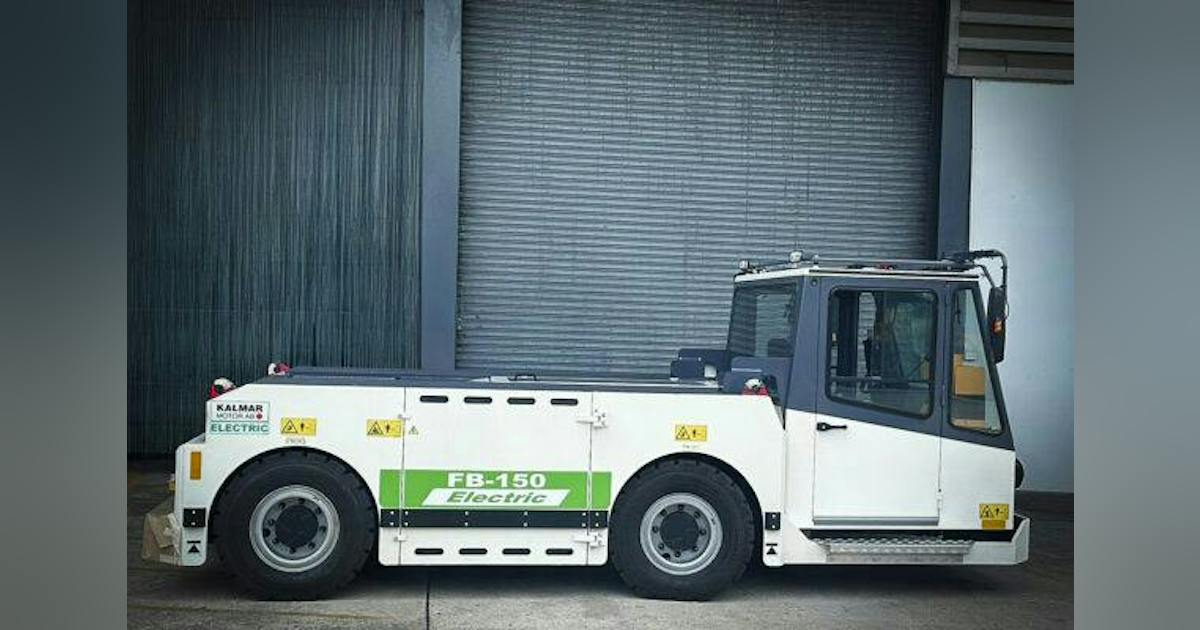
Kalmar Motor has relaunched its FB150 electric tow tractor with a more competitive list price, pitching the pushback unit as one “built to help customers electrify their fleets on their own terms” as lead-acid and lithium-ion battery options compete on cost. The Swedish manufacturer, part of Kalmar Motor‘s parent group Vestergaard Company, announced the relaunch at GSE Expo Europe 2026 in Lisbon in September.
The FB150 is built for narrow-body aircraft pushback, inter-gate towing and short-distance maintenance towing, and Kalmar Motor says it also suits cargo and industrial handling. Kalmar has not published a list price, and the company’s own announcement describes the change only as “more competitive” without a figure, so buyers will need a direct quote before putting it against a budget line.
On specification the tractor delivers 100 kN of tractive effort and weighs between 12,000 and 15,000 kilograms depending on ballast. Top speed is 25 km/h running independently and 20 km/h while towing, and the operator console is centrally mounted and swivels 180 degrees, removing the need to reposition the towbar between forward and reverse moves.
“We are re-launching the FB150 because the market is asking for a cost-effective electric pushback solution that does not compromise on flexibility,” said Carsten Schimkat, Kalmar Motor’s vice president of sales, in comments carried by AviationPros. “With the choice of lead-acid or lithium-ion batteries, a highly competitive purchase price, and a very low cost per pushback, the FB150 is built to help customers electrify their fleets on their own terms.”
For ground handlers already running electrification programmes, this is a straightforward fleet-replacement option rather than a reason to change strategy. Handlers with turnaround volumes tied to airports pushing clean-tech procurement, such as the three schemes Bristol Airport backed from 28 bids, will find the battery choice useful: lead-acid keeps upfront cost down where charging infrastructure is limited, lithium-ion suits bases that already have fast-charging in place. Operators scaling up cargo-side ground handling, including at new hubs like WFS’s 25,400m² cargo facility at Lyon Airport, are the kind of buyer with the towing volume to make a lower cost-per-pushback figure matter quickly.
It is not the only option on a shortlist. Buyers comparing electric pushback tugs typically set Kalmar Motor’s new pricing against Textron‘s electric GSE range, including the TUG MX4, which tows 20,000lbs, alongside remote-operated units from Mototok, French manufacturer Charlatte Manutention and the wider ground support catalogue from TLD. None of those four has published a head-to-head price against the FB150, so the comparison will come down to a direct quote request to each.
The practical step for a ground handling or airside operations manager is to request Kalmar Motor’s new FB150 pricing directly, specify battery chemistry against existing charging infrastructure, and put it alongside at least one of Textron, Mototok, Charlatte or TLD before committing budget.
Image: aviationpros.com